

Hydroponics is the technique of growing plants using a water-based nutrient solution rather than soil, and can include an aggregate substrate, or growing media, such as vermiculite, coconut coir, or perlite. Hydroponic production systems are used by small farmers, hobbyists, and commercial enterprises.
According to USDA: "Growing plants in water culture or sand culture without soil are procedures that have been used by physiologists studying plant nutrition and by other plant scientists for more than a century." (Growing Crops Without Soil. Beltsville, MD: USDA, rev 1965.)
This page provides links to current and historical research publications as well as information from universities and extension.
Hydroponics for Home Growers
-
Hydroponics [okstate.edu]
Learn about the history of hydroponics, growing systems, nutrient management, and more. Hydroponics is used to cultivate ornamental crops, herbs, and multiple vegetable types including cucumbers, lettuce, peppers, and tomatoes. Growing systems can be designated as either liquid (closed) or aggregate (open or closed), with the closed-types requiring Nutrient Management Techniques.
-
Building a Floating Hydroponic Garden [ifas.ufl.edu]
Follow this step-by-step guide and companion video to create a floating hydroponic garden.
-
Hydroponic Greenhouse. Virtual Field Day Videos [ifas.ufl.edu]
View the Greenhouse Workshop Videos on setting up a hydroponics greenhouse, starting and growing crops, and harvesting and marketing.
-
Home Hydroponics [illinois.edu, 1,071 KB]
Find introductory hydroponic information for the home grower.
-
Ask your Extension Service Agent [nifa.usda.gov]
Your local Extension Service Agent may provide information and advice on everything from building a small hydroponics system to selecting plants.
-
Hydroponics at Home [unh.edu]
Read this factsheet for non-commercial hydroponic growers on how to build an in-home system, types of systems, growing small crops, and challenges.
Explore Books Online
Hydroponic Food Production
A Definitive Guidebook for the Advanced Home Gardener and the Commercial Hydroponics Grower. Resh, Howard M. Woodbridge Publishing Company. 5th ed. 1997
Aquaculture and Hydroponics 1968-1978
Charles N. Beebe
Bibliographies and Literature of Agriculture, BLA-2, May 1979
USDA. National Agricultural Library
Water-Culture Method for Growing Plants Without Soil
Hoagland, D.R. and D.I. Arnon. Berkeley, CA: University of California, 1950.
Research and Discoveries
The Vegetable Crops Hotline offered this quote: "The first research published on the production of spearmint in water was conducted by John Woodward in 1699. Discoveries made in the late 19th century by German scientists Sachs and Knop resulted in the development of the technique of soilless cultivation. This work inspired Dr. W.F. Gericke (University of California) in the 1920’s to develop a solution culture technique. Following his work, Hoagland and Arnon (University of California) developed a complete hydroponic nutrient solution in 1938, the ‘Hoagland Solution’. The solution was modified several times by different researchers. However, the soilless cultivation technique was first used on a large scale during World War II to produce food for the American troops stationed on the in fertile Pacific islands." [Langenhoven, P. "Opportunities in Hydroponics." Vegetable Crops Hotline. 609: March 14, 2016]
The History of Soilless Growing

Stuart, Neil W. "About Hydroponics," In: Science in Farming: The Yearbook of Agriculture 1943-1947. USDA. U.S. Government Printing Office, 1947.

View: Image of Growing Crops Without Soil. Beltsville, MD: USDA, revised 1965. History Collection. Series II. Box 2/21. Folder: "Hydroponics. 1965-1979." Special Collections, USDA National Agricultural Library.
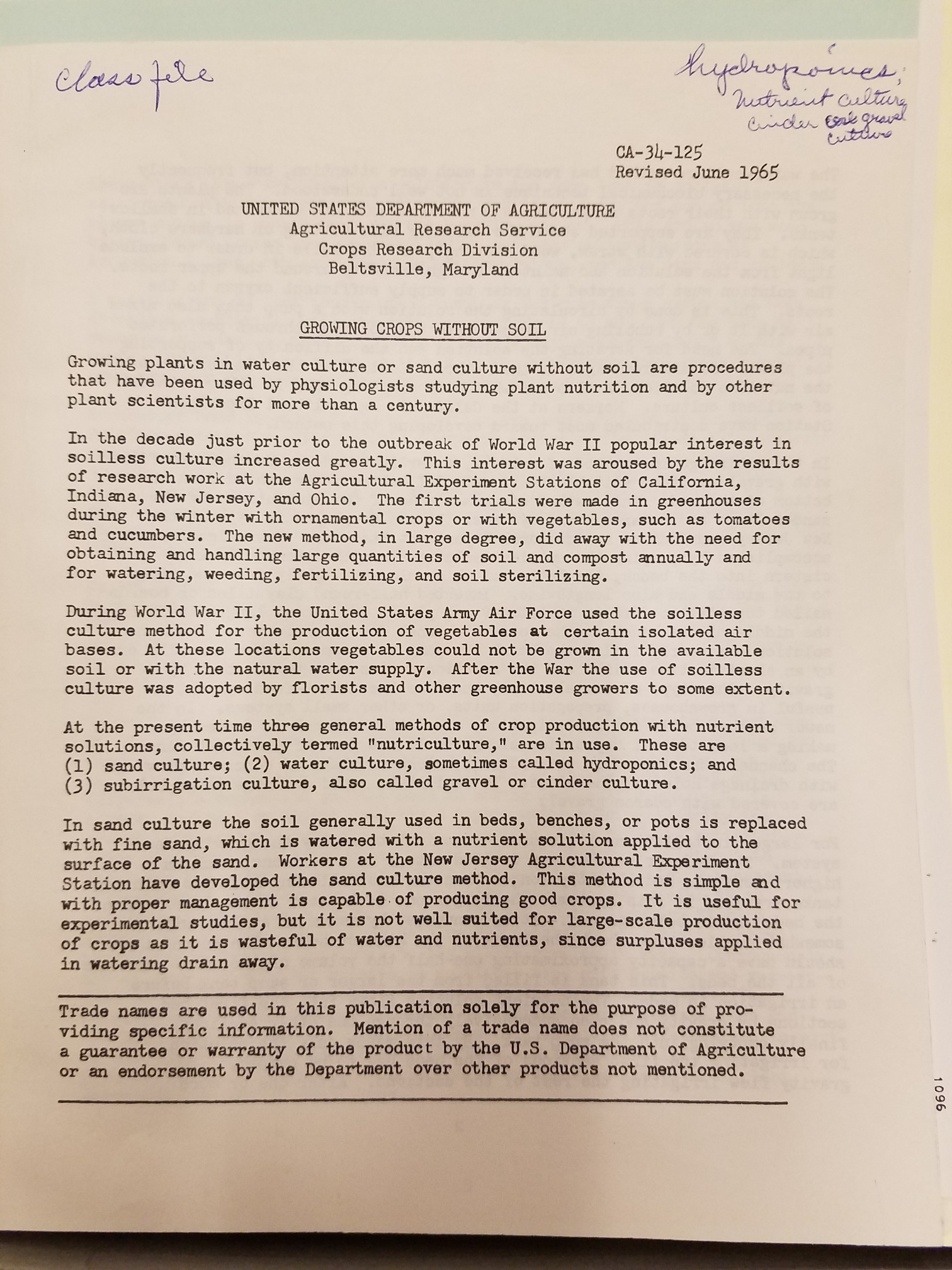

Image of "General Mills' Big Gamble on Indoor Farming." Dun' Review. 1979. History Collection. Series II. Box 2/21. Folder: "Hydroponics. 1965-1979." Special Collections, USDA National Agricultural Library.
